Cooking with wine
White Wine for Risotto: Which Wine, How Much and When to Add It
By the editorial team · Updated 2026-11-25 · Every number linked to its source
Quick answer. Use a crisp, dry, unoaked white such as Sauvignon Blanc, which came out best for risotto in America's Test Kitchen's testing 4. Pillsbury's classic version pairs 1 cup of wine with 1 1/2 cups of Arborio 1.
How much of the bottle will you use?
Risotto usually takes about 1 cup of wine for 1½ cups of rice 1; add any other recipe you're making this week to see how much of the bottle is left to freeze.
750 ml standard bottle; freezing tip from America's Test Kitchen. 23
Want it on paper? The Cooking Wine Cheat Sheet has every dish, wine style and substitute on printable pages.
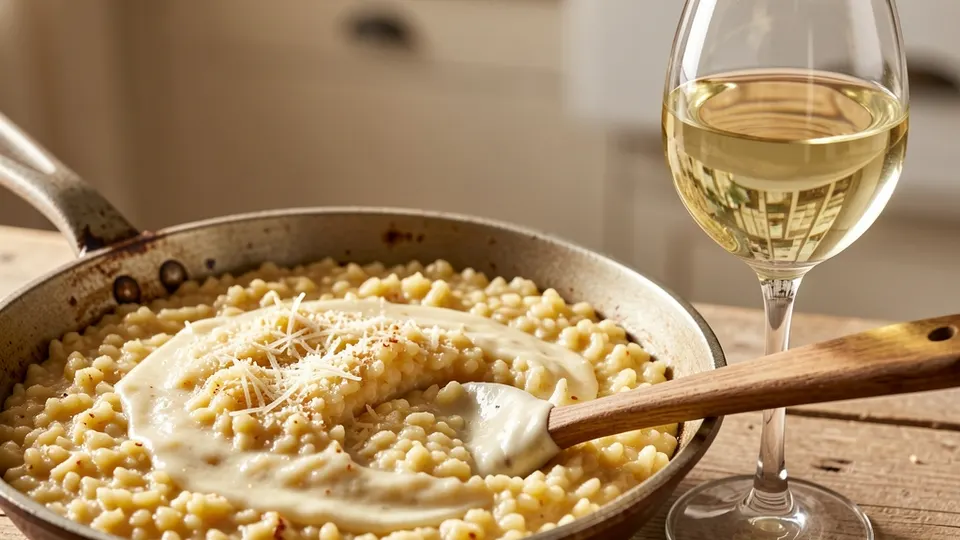
White wine for risotto does one job: it adds a clean, bright edge to rice that is otherwise rich, starchy and mild. Because risotto is so gently flavored, it's one of the dishes where the bottle you pick actually shows. America's Test Kitchen found that differences between wines were most noticeable in delicate dishes like risotto and beurre blanc 4.
This page covers which styles work, which to avoid, how much wine to use for the amount of rice you're cooking, when it goes into the pot, and what to use if you'd rather leave wine out.
The best white wine for risotto
Reach for a dry, unoaked white with good acidity. In ATK's test of five recipes, risotto among them, Sauvignon Blanc stood out: it was the one grape that reliably reduced to a tidy, tart flavor every time 4.
Other dry whites ATK lists as good cooking wines include Pinot Grigio, Chenin Blanc and Albariño 5. Any of these will work in a basic risotto. The general principle from that same ATK piece: an "unremarkable" wine, bright and balanced, beats one with strong oak, tannin or sweetness.
Dry vermouth is a handy backup. It placed a close second to Sauvignon Blanc in ATK's testing 4, and because an open bottle lasts so long in the fridge, it's the easiest wine to keep around for a weeknight pot.
Wines to avoid in risotto
Oaky Chardonnay. Inexpensive Chardonnay is often heavily oaked, and ATK found the oak turned bitter rather than woody once cooked 4. Unoaked Chardonnay is fine; read more on Chardonnay for cooking.
Sweet or off-dry whites. In ATK's trial, the sugar in off-dry Riesling fought with nearly every recipe 4.
USDA numbers back that up: Muscat carries more than twice the carbohydrate of Sauvignon Blanc per 100 g 6 7.
Dry sherry. It works in robust dishes, but in ATK's test its earthy notes overpowered risotto and beurre blanc 4. Save it for a hearty braise; see dry sherry for cooking.
Salted cooking wine. Risotto is already seasoned through the broth, and supermarket cooking wine adds a lot of salt. See can you drink cooking wine for the numbers.
How much wine in risotto
Pillsbury's classic risotto uses 1 cup of dry white wine for 1 1/2 cups of Arborio rice and a 32-ounce carton of chicken broth, making four servings 1. That ratio is an easy starting point to scale:
| Arborio rice | Dry white wine | Chicken broth |
|---|---|---|
| 3/4 cup | 1/2 cup | 16 oz |
| 1 1/2 cups | 1 cup | 32 oz |
| 3 cups | 2 cups | 64 oz |
The middle row is the Pillsbury recipe; the others simply halve or double it. A standard 750 ml bottle holds about 3.2 cups 2, so a four-serving pot uses roughly a third of the bottle.
If you prefer a lighter wine note, you can use less wine and make up the liquid with more broth. The total liquid is what the rice needs; the wine is flavor.
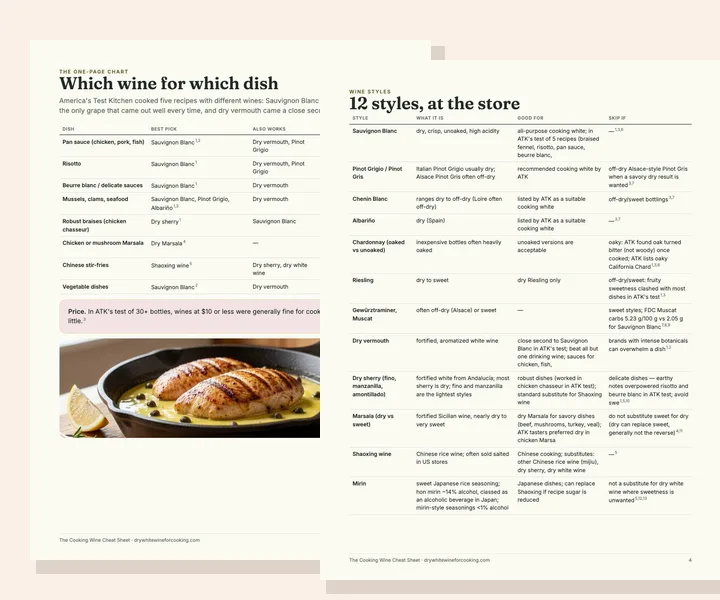
Free printable · 13 pages
Get The Cooking Wine Cheat Sheet
Grab the free Cooking Wine Cheat Sheet: the how-much-wine chart scales risotto, pan sauces and braises by serving, with the best bottle for each.
- Which wine for which dish, on one page
- 12 wine styles: what to buy, what to skip
- Every substitute with its ratio
- USDA alcohol-left table, storage notes · US Letter and A4
When to add the wine
In a classic method, the wine goes in after you've softened the onion and toasted the rice in fat, and before the first ladle of broth. Stir until the rice has absorbed most of it, then start adding hot broth a ladle at a time.
Adding wine early gives it time to simmer with the rice as the broth goes in over the next stretch of cooking. Per the USDA retention table, a dish simmered for about 15 to 30 minutes keeps roughly 40% to 35% of the alcohol added 8. If that matters for who you're feeding, the does alcohol cook off page explains the numbers.
A splash at the very end, after the cheese, gives a sharper wine flavor, but it also keeps more alcohol, since wine stirred into hot liquid and pulled from the heat retains about 85% 8.
Matching the wine to your risotto
A basic Parmesan risotto is where a clean, neutral white matters most, since there's little else to hide behind. As other flavors in the pot get stronger, you have a bit more room.
- Seafood or lemon risotto: stick to a tart, unoaked Sauvignon Blanc or Pinot Grigio. Acidity is the point, and anything oaky or sweet will stand out.
- Mushroom risotto: a dry white still works best. Dry vermouth is a fair alternative, since its slightly herbal edge sits well with mushrooms.
- Spring vegetable risotto (peas, asparagus): a light, unoaked white keeps the dish fresh.
Whichever you choose, taste the wine first. If you wouldn't want that flavor in the finished dish, the reduction will only make it stronger. Our Sauvignon Blanc for cooking and Pinot Grigio for cooking pages go deeper on each grape.
White wine for risotto substitutes
If you're out of wine or skipping alcohol, keep the brightness some other way. America's Test Kitchen suggests replacing 1/2 cup white wine with 1/2 cup broth plus 1 tsp of wine vinegar or lemon juice 9. Another ATK piece gives 1/2 tsp of acid for the same amount of broth 3, so start with the smaller amount and taste.
For risotto, stir the acid in near the end rather than at the start, as ATK advises for soups and pan sauces, so it stays fresh 9. White grape juice is also listed as a 1:1 swap, but it's sweeter than wine 10, which can feel out of place in a savory risotto.
For more swaps and ratios see substitutes for white wine in cooking.
Frequently asked questions
How to make risotto with white wine?
Soften onion in butter or oil, toast the rice for a minute, then pour in the wine and stir until mostly absorbed. Add hot broth a ladle at a time, stirring, until the rice is creamy and just tender. For four servings, Pillsbury calls for a cup of wine, 1 1/2 cups of Arborio and a 32-ounce carton of broth 1.
What's a dry white wine?
For cooking purposes, a dry white is one with little or no residual sugar, so it tastes tart rather than sweet. EU law sets the limit for a still wine labeled dry at 4 g of sugar per liter, or up to 9 g with enough acidity 11. For risotto, Sauvignon Blanc and Italian Pinot Grigio are reliable dry picks.
How important is white wine in a recipe?
In risotto it matters more than in most dishes, because the rice is mild and the wine's acidity balances the butter and cheese. ATK found wine differences showed most in gentle dishes like risotto 4. You can still leave it out: replace it with broth and a little lemon juice or wine vinegar near the end.
What is the secret to creamy risotto?
Our sources focus on the wine rather than technique, so here is the wine side: pick a clean, dry, unoaked white, because gently flavored dishes like risotto show wine differences most 4. Oaky or sweet wines can turn bitter or cloying once reduced. Creaminess itself comes from the rice's starch and gradual stirring with hot broth.
Sources
- Pillsbury: Classic Risotto
- US eCFR / Cornell LII (TTB regulation), 2025: 27 CFR 4.72 — Standards of fill for wine
- America's Test Kitchen: Cooking with wine (how-to 5706)
- America's Test Kitchen / Cook's Illustrated: What's the best white wine for cooking?
- America's Test Kitchen / Cook's Illustrated: The best wine for cooking is not what you think
- USDA FoodData Central (SR Legacy), 2019: Alcoholic beverage, wine, table, white, Muscat (FDC ID 174849)
- USDA FoodData Central (SR Legacy), 2019: Alcoholic beverage, wine, table, white, Sauvignon Blanc (FDC ID 173201)
- USDA Agricultural Research Service, Nutrient Data Laboratory, 2007: USDA Table of Nutrient Retention Factors, Release 6
- Cook's Illustrated / America's Test Kitchen: How to substitute for wine
- Healthline (Brianna Elliott, RD), 2017: 11 non-alcoholic substitutes for wine (cooking)
- European Commission (text via legislation.gov.uk), 2019: Commission Delegated Regulation (EU) 2019/33, Annex III Part B — sugar content terms for wines other than sparkling