Cooking with wine
Does Alcohol Cook Off? What the USDA Numbers Show
By the editorial team · Updated 2026-11-25 · Every number linked to its source
Quick answer. Not completely. According to the USDA retention table, cooked food keeps anywhere from 5% to 85% of the alcohol you add, depending on method and time 1. Even 2.5 hours of simmering leaves about 5%.
How much alcohol is left?
Pick your cooking method and time in the alcohol retention calculator to see roughly what share of the wine's alcohol stays in the dish.
USDA Table of Nutrient Retention Factors. 12
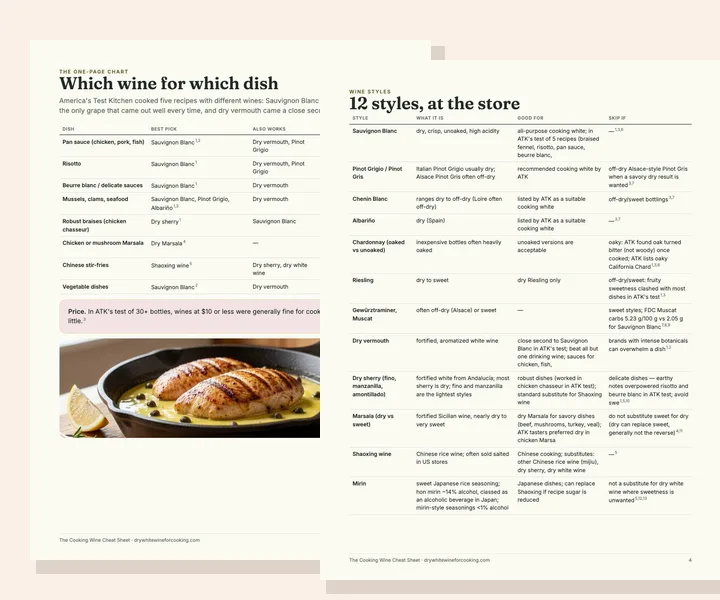
Want it on paper? The Cooking Wine Cheat Sheet has every dish, wine style and substitute on printable pages.
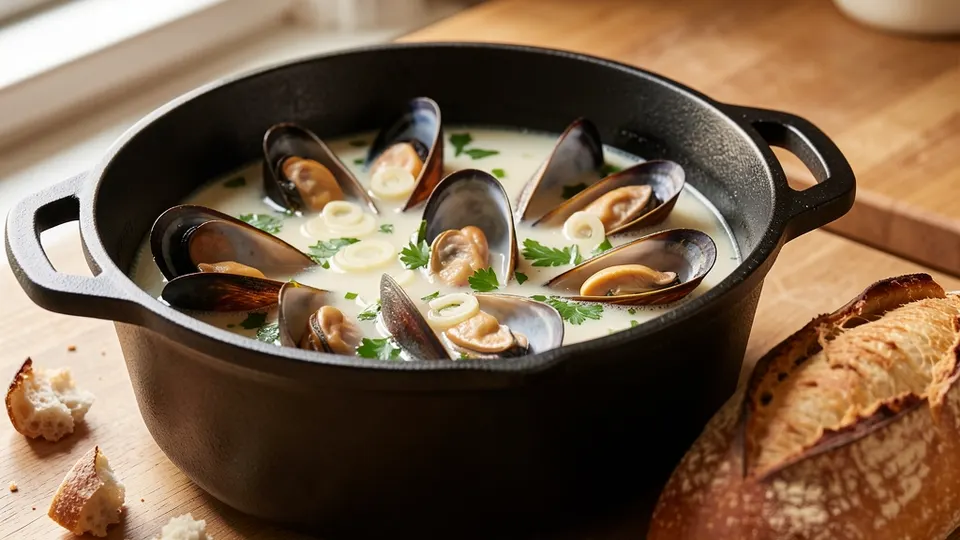
Does alcohol cook off when you add wine to a sauce or stew? Some of it does, but less than most people assume, and never all of it. The best data comes from the USDA's table of nutrient retention factors, which lists how much alcohol remains after common cooking methods 1.
Below you'll find that table in plain language, what makes a dish hold on to more or less alcohol, and two everyday examples: a quick pan sauce and a long braise. At the end we cover what the numbers mean for kids, guests who don't drink and anyone avoiding alcohol, without making medical calls for you.
Does alcohol cook off? The USDA retention table
The USDA table gives a retention percentage for each method: the share of the alcohol you added that is still there when the food is done 1.
| Method | Alcohol retained |
|---|---|
| Stirred into boiling liquid, then removed from heat | 85% |
| Flamed (flambé) | 75% |
| No heat, stored overnight (marinade) | 70% |
| Baked 25 min, not stirred in | 45% |
| Stirred in, baked or simmered 15 min | 40% |
| Stirred in, simmered 30 min | 35% |
| Stirred in, simmered 1 hr | 25% |
| Stirred in, simmered 1.5 hr | 20% |
| Stirred in, simmered 2 hr | 10% |
| Stirred in, simmered 2.5 hr | 5% |
Iowa State University Extension reproduces the same figures 2. The full table is also in our cheat sheet, laid out for the fridge door.
How to read the numbers
Retention is a percentage of what you added, not a percentage of the finished dish. If a recipe calls for a large pour of wine, 25% of a lot can still be noticeable; 25% of a splash is small. The table tells you the share, and the recipe tells you the starting amount.
Time matters most. The drop is steep in the first hour, from 40% at 15 minutes to 25% at one hour, then it slows, reaching 5% only after 2.5 hours 1.
The ranges you see quoted online differ slightly. The USDA table and Iowa State give 5% to 85% 2. Idaho State University cites the 1992 USDA-funded study as 4% to 95% 3. The table above uses the USDA's own published codes.
What makes a dish keep more alcohol
The table assumes typical conditions, and your pan can shift the result. Smaller pans retain more alcohol, while a larger surface and stirring increase evaporation, according to Idaho State University 3.
In practice that means a wide skillet at a lively simmer loses alcohol faster than a narrow, lidded pot. A covered braise in the oven traps vapor, so treat the table as a rough guide rather than a precise reading for your specific dish.
Flambé is the method people most often overestimate. The flame looks dramatic, yet the USDA figure for flamed dishes is 75% retained 1. The burn is brief and mostly takes alcohol from the surface.
Free printable · 13 pages
Get The Cooking Wine Cheat Sheet
Download the Cooking Wine Cheat Sheet for the full USDA alcohol retention table on one printable page, next to alcohol-free swaps for every dish.
- Which wine for which dish, on one page
- 12 wine styles: what to buy, what to skip
- Every substitute with its ratio
- USDA alcohol-left table, storage notes · US Letter and A4
Two everyday examples
A quick pan sauce. Take ATK's white wine pan sauce: half a cup of wine and three-quarters of a cup of broth, boiled down and whisked with butter to serve four 4. A sauce like this simmers for minutes, not hours, so the closest USDA rows are 85% to 40% 1. Expect a good share of the alcohol to remain.
A long braise. A beef stew or other braise that simmers for an hour or two is a different story. There the USDA figures fall to 25% at one hour and 10% at two 1. Less remains, but not zero.
A marinade. Wine in a marinade that isn't cooked off keeps about 70% of its alcohol overnight 1. Some of that is lost once the meat hits the heat, depending on how you cook it.
How to cook off more of the alcohol
If you want the flavor of wine with less of its alcohol, timing and pan choice help more than anything else. These steps follow from the USDA table and Idaho State's notes on evaporation 1 3.
- Add the wine early. Pour it in after browning, before the rest of the liquid, so it simmers for the full cooking time rather than a few minutes.
- Reduce it on its own first. Let the wine bubble in the open pan until it has visibly reduced before adding broth or tomatoes.
- Use a wide pan and leave the lid off while it reduces, and stir. A larger surface speeds evaporation.
- Skip the last-minute splash. Wine stirred into hot liquid right before serving keeps the most alcohol of any cooked method.
None of these takes the alcohol to zero. If zero is the goal, a substitute is the only reliable route.
Does wine cook out of salted cooking wine?
The same physics applies. Salted supermarket cooking wine still contains alcohol: USDA lists 3.3 g per 100 g for the generic product 5. It isn't an alcohol-free alternative, so it doesn't help if the goal is to avoid alcohol. More on that bottle in can you drink cooking wine.
Kids, guests who don't drink and alcohol-free cooking
We don't give medical or religious rulings, and no reputable source we found sets a child-specific threshold. What the USDA numbers do show is that some alcohol remains after any normal cooking time 1. You can decide what that means for your table.
Idaho State University advises that people in recovery, pregnant or breastfeeding women, and anyone avoiding alcohol for religious, health or other reasons should know not all of it burns off and may want to skip those recipes 3. Iowa State adds that for someone in recovery, even a small amount or the taste of alcohol can be a powerful cue 2.
The simplest answer is a swap. Broth plus a little wine vinegar or lemon juice covers most savory recipes, and white grape juice works where a touch of sweetness fits. See substitutes for white wine in cooking for ratios.
Frequently asked questions
Can children eat food made with cooking wine?
We can't make that call for you, and no reputable source we found gives a child-specific limit. The USDA table shows food keeps between 5% and 85% of added alcohol depending on method and time 1, and salted cooking wine contains alcohol too. If you'd rather avoid it, use broth with a little vinegar or lemon juice instead.
Does white cooking wine have any alcohol in it?
Does cooking with wine remove the alcohol?
It removes some, never all. Stirring wine into boiling liquid and taking it off the heat leaves about 85%, a 30-minute simmer about 35%, and even 2.5 hours leaves roughly 5%, per the USDA retention table 1. Wide pans and stirring speed evaporation; small covered pots slow it.
Is cooking wine halal?
We don't give religious rulings, and we found no reputable source to cite on this question. The facts we can share: salted cooking wine contains alcohol 5, and cooking doesn't remove all of it. If you avoid alcohol for religious reasons, a religious authority you trust is the right person to ask, and alcohol-free substitutes are easy to use.
Sources
- USDA Agricultural Research Service, Nutrient Data Laboratory, 2007: USDA Table of Nutrient Retention Factors, Release 6
- Iowa State University Extension and Outreach (AnswerLine), 2016: How much alcohol is left in foods when cooking
- Idaho State University (Barbara Gordon, RDN), 2019: Alcohol cooks out… or does it?
- America's Test Kitchen / Cook's Illustrated: White Wine Pan Sauce (recipe 7794)
- USDA FoodData Central (SR Legacy), 2019: Alcoholic beverage, wine, cooking (FDC ID 169070, NDB 43154)
- US eCFR / Cornell LII (TTB regulation), 2025: 27 CFR 24.215 — Production of nonbeverage wine and wine products